Between two mermaids — the Northern capitals by van, 16 days
8-23 agosto 2026
A 7,664 km loop from Tigliole to the Baltic and back, 8–23 August 2026, strung between two opposite mermaids: the warrior of Warsaw, sword raised and shield in hand, and the melancholy one of Copenhagen, sitting on her rock. In between: nine capitals, two days among the forests and lakes of eastern Finland, two in the fjords of Sognefjord and Geiranger, and two ferries that cut across the Baltic while you sleep. You can also join for a single leg, sharing the running costs.
Map
Detailed itinerary
Between two mermaids
The trip begins in front of one mermaid and ends in front of another, and the two could hardly be more different.
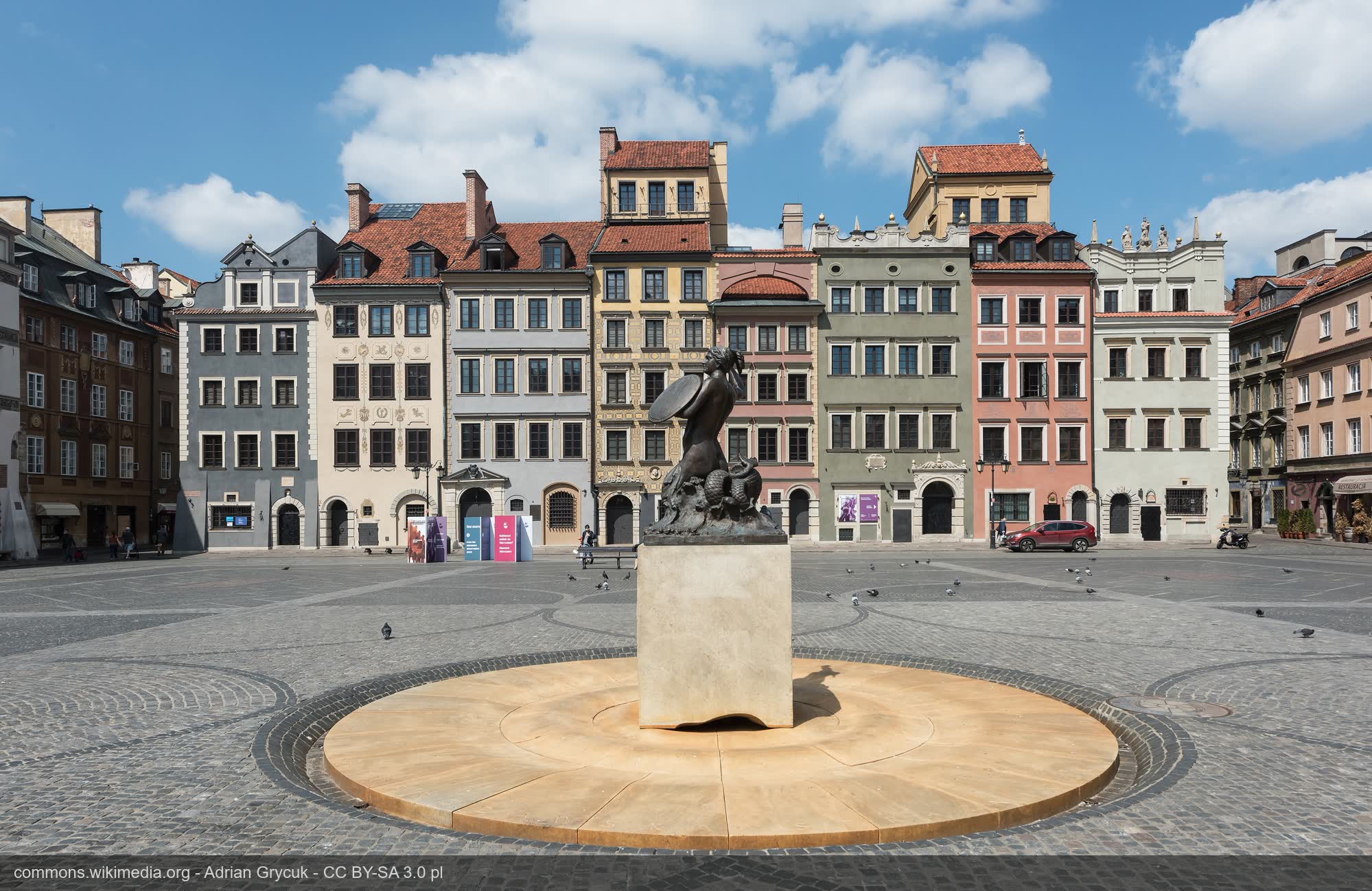
Warsaw's Syrenka stands in the middle of the Old Town Market Square with her sword raised and her shield up. She is a warrior: she defends the city, and she has been on Warsaw's coat of arms for centuries. Twelve days and a few thousand kilometres later, on her rock at Langelinie in Copenhagen, Andersen's Little Mermaid sits small and melancholy, reliably disappointing anyone who walks out expecting something grand.
A warrior on the way out, a dreamer on the way home. In between: seven more capitals, the forests of the Finnish lakeland, two ferries and the Norwegian fjords.
One more thing divides them, out of the water this time: the first may be photographed, the second may not. The Little Mermaid is the work of Edvard Eriksen, who died in 1959, and Danish freedom of panorama does not cover artworks when they are the main subject of the shot: images of her remain under copyright until 1 January 2030, and the heirs do enforce it — one Danish newspaper was fined 285,000 kroner. Which is why on this page she is described rather than pictured.
You can join for just one leg
Almost nobody can free up sixteen days at short notice. So the empty seat isn't necessarily
for the whole trip: you can join for a single leg, flying in to meet the van and flying
home from another capital.
| Leg | Join | Leave | What it crosses |
|---|---|---|---|
| The Baltic · 5 days | Warsaw, Sunday 9 August, evening | Helsinki, Friday 14 August | Vilnius, Riga, Tallinn and the ferry across the Baltic |
| The lakes and the ship · 4 days | Helsinki, Thursday 13 August, evening | Stockholm, Monday 17 August | Repovesi, Savonlinna, the overnight ship from Turku, a day in Stockholm |
| The fjords · 5 days | Oslo, Monday 17 August, evening | Copenhagen, Saturday 22 August | Sognefjord, Flåm, Geiranger, Göteborg |
We always meet in the evening, at a campsite, and that matters: on the three joining days
(9, 13 and 17 August) the van is in transit and arrives in the afternoon. If you land in the
morning the city is yours until we meet; we set off together the next morning. Every joining
and leaving city has an airport with direct flights from Italy.
How the costs work
This is not an organised trip and there is no price: it is my own journey, and you can
join it by sharing the running costs. Fuel, ferries, tolls, bridges and campsites are
added up for the days we travel together and split between whoever is on board. Your flight
to reach the van and your food stay with you.
Exactly how much cannot be known in advance: it depends on fuel prices in the countries
we cross, on campsite rates and above all on the overnight Turku-Stockholm ferry, whose fare
for a 1.99 m high vehicle is only known at booking. I can put together a purely indicative
estimate for the leg you are interested in, to be agreed together before we leave: write to
me and we'll talk it through.
Nobody pays anything up front: costs are paid as they arise and split on the spot.
In two numbers
7,664 km and 95.9 hours of driving across 16 days: six hours behind the wheel per day on average. Only one day runs past ten hours, and it's the first one, the one that gets us out of Italy. Every other day stays below, and four of them stay under five hours.
Every distance and driving time on this page was computed leg by leg with a routing engine on OpenStreetMap data. Nothing here is a guess.
Day by day
| Day | Leg | km | Driving |
|---|---|---|---|
| Sat 8 | Tigliole → Vienna | 980 | 10.1 h |
| Sun 9 | Vienna → Warsaw | 671 | 7.1 h |
| Mon 10 | Warsaw → Vilnius | 511 | 5.6 h |
| Tue 11 | Vilnius → Riga | 293 | 3.8 h |
| Wed 12 | Riga → Tallinn | 313 | 4.8 h |
| Thu 13 | Tallinn → ferry → Helsinki | 88 | 2.3 h |
| Fri 14 | Helsinki → Repovesi → Savonlinna | 388 | 6.0 h |
| Sat 15 | Savonlinna → Tampere → Turku + overnight ferry | 526 | 7.3 h |
| Sun 16 | Stockholm, full day | — | — |
| Mon 17 | Stockholm → Oslo | 529 | 7.0 h |
| Tue 18 | Oslo → Flåm, Sognefjord | 312 | 5.2 h |
| Wed 19 | Flåm → Geiranger | 280 | 4.8 h |
| Thu 20 | Geiranger → Oslo | 447 | 6.6 h |
| Fri 21 | Oslo → Gothenburg → Copenhagen | 608 | 7.3 h |
| Sat 22 | Copenhagen → Würzburg | 978 | 9.9 h |
| Sun 23 | Würzburg → Tigliole | 740 | 8.1 h |
The three movements
Baltic capitals (days 1-6). Straight up to the north-east: Vienna is an overnight stop on the way to Warsaw, then Vilnius, Riga and Tallinn come one a day, each with half a day to spare. All three are walkable in a few hours, and the hops between them are short — 300 to 500 km, never more than six hours.
Finnish forests and lakes (days 7-8). The part a "capitals" itinerary always skips, and the one that lets this trip breathe. Repovesi national park — rock, pine and the Lapinsalmi suspension bridge — opens the Finnish lakeland; the night is spent in Savonlinna, where the medieval castle of Olavinlinna stands literally in the water. The next day crosses the Lakeland westwards to Turku and the ferry.
The fjords (days 11-12). From Oslo west to the Sognefjord, Norway's longest, and to Flåm; the next day up to Geiranger, a UNESCO site. Two days are not many for western Norway, but they are enough for the two fjords worth the drive.
Stop by stop: what to see and where to put the van
The van stands 1.99 m tall, and nearly every underground car park in Europe has a 1.90 or 2.00 m barrier. Hence the rule that holds for every city on this trip: sleep at a campsite on the edge of town and take public transport into the centre. It isn't a compromise, it's the fastest and cheapest strategy — and half a day goes further that way than circling in search of a space.
Vienna · day 1 — the night only
Van: Reisemobil Stellplatz Wien (motorhomes only, metro five minutes away, centre in half an hour) or MICAMPA Wien Donau, Am Kaisermühlendamm 123, a ten-minute walk from the U2.
To see: nothing. You arrive after ten hours of driving and you sleep. At most a stroll on the Donauinsel to stretch your legs.
Warsaw · day 2
Van: Camping Motel WOK (Odrębna 16), recognised by the Polish camping federation, or Camping Warszawa at Michałowice, 15 km from the centre.
Half a day on foot: the Old Town — a UNESCO site precisely because it was rebuilt stone by stone after the total destruction of 1944 — with the Market Square and the Royal Castle; then down Krakowskie Przedmieście to Nowy Świat. In the middle of the square stands the Syrenka: bronze, sword raised, shield up. The first of the trip's two mermaids, and the only one who lets herself be photographed. The Palace of Culture, Stalin's gift, is visible from every corner of the city. With time to spare: the Warsaw Uprising Museum, or POLIN on the history of Polish Jews.
Vilnius · day 3
Van: City Camping Vilnius, a car park converted into a motorhome site for the summer season, around €33 a night, centre reachable by bike or public transport.
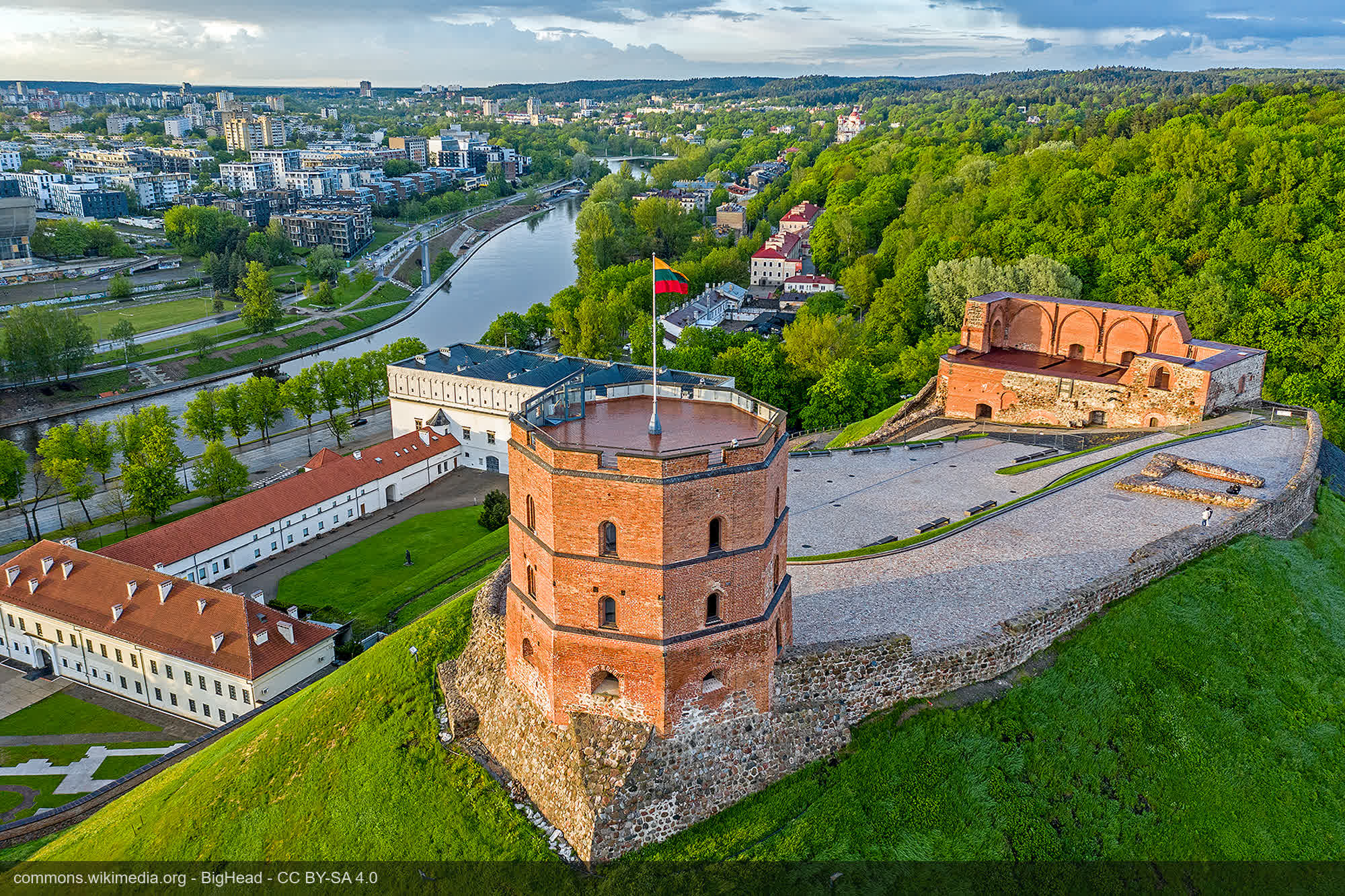
Half a day on foot: the largest baroque old town in eastern Europe (UNESCO). Cathedral and bell tower, the Gediminas Tower for the view from above, St Anne's church, the Gate of Dawn. And then Užupis, the quarter that declared itself an independent republic and posted its constitution on plaques in dozens of languages: ten minutes from the cathedral and another city entirely.
Riga · day 4
Van: Riga City Camping, from €22 a night, guarded, a two-kilometre walk from the centre. Alternatively a guarded car park right by the old town, €2-7 a day, where sleeping in a campervan is allowed.
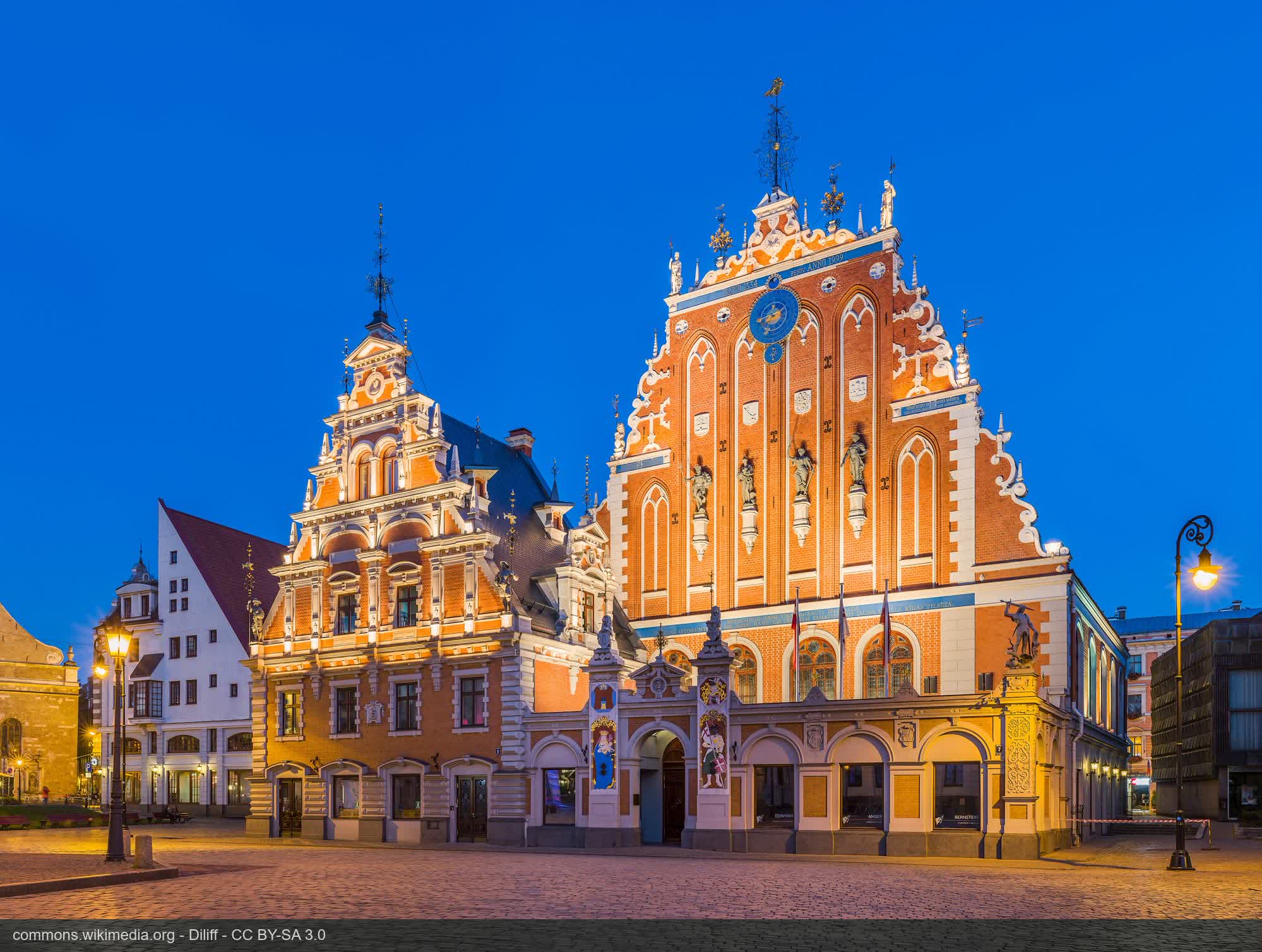
Half a day on foot: the UNESCO old town with the House of the Blackheads, the cathedral and the Three Brothers; the Central Market built inside former Zeppelin hangars; and above all Alberta iela, the Art Nouveau street. Riga has the highest concentration of it in Europe, and it's the reason to linger here more than elsewhere in the Baltics.
Tallinn · day 5
Van: Pirita Harbour, €35 per 24 hours regardless of the number of people, with electricity, showers, sauna and round-the-clock security, and the beach next door. Or Tallinn City Camping, on tarmac, about an hour's walk from the old town.
Half a day on foot: one of the best-preserved medieval old towns in Europe. Climb Toompea for the Alexander Nevsky orthodox cathedral and the two viewpoints of Kohtuotsa and Patkuli, then drop down to Raekoja plats and follow the walls and towers. If time remains, Telliskivi: former industrial sheds turned creative quarter.
Helsinki · day 6
Van: Rastila Camping, €37-38 a night, 165 pitches, with a metro station 150 metres away and the centre 18 minutes off. The campsite says it itself: parking a large vehicle in central Helsinki is expensive and difficult, better to leave it and take the metro.
Half a day: Senate Square with its white cathedral, the Uspenski orthodox cathedral, the Temppeliaukio church carved into bedrock, the Oodi library and the harbour market. If the Tallinn ferry lands early, Suomenlinna: the UNESCO sea fortress spread over six islands, fifteen minutes by boat from Kauppatori. It is worth half a day on its own.
Repovesi and Savonlinna · day 7
Van: campsites along the lake road; the national park has car parks at the trailheads.
To see: at Repovesi the Lapinsalmi suspension bridge, swaying over an arm of lake between rock and pine — the symbol of the park. At Savonlinna the castle of Olavinlinna, founded in 1475 and planted literally in the middle of the water, one of the northernmost medieval castles in the world.
Turku · day 8
You arrive for the 20:55 sailing. If you're early: Turku castle and the cathedral along the Aura river.
Stockholm · day 9 — full day
Van: Långholmens Husbilscamping, the only motorhome campsite inside Stockholm, on the island of Långholmen: 77 hard-standing pitches, open in summer, with fresh water and waste disposal. ⚠️ Booking is required, well in advance — it is very popular. Alternative: Ställplats Stockholm, open all year, with a bus into town. On the street, parking is capped at 24 hours and free camping in the city is not permitted.
Full day: Gamla Stan, the old town on its island, with the Royal Palace; the Vasa museum, holding the 1628 warship that sank in the harbour on her maiden voyage and was raised intact three centuries later — the most visited museum in Scandinavia, and deservedly; the park-island of Djurgården with Skansen; and the City Hall, the one with the Nobel banquet room.
Oslo · day 10
Van: Topcamp Ekeberg, Ekebergveien 65, on a hill ten minutes from the centre by tram or bus, open May to September. Pitches up to 7 metres: the Transporter fits easily. Street parking for large vehicles in Oslo is extremely limited, so the campsite-plus-transit rule counts double here.
Half a day: ⚠️ the Viking Ship Museum is closed — under reconstruction since 2021, reopening as the Museum of the Viking Age only in 2027. Anyone turning up for the ships finds a building site: the Viking finds are meanwhile displayed at the Historical Museum, right in the centre. What remains: the roof of the Opera House, which you walk up to the top of; the Munch Museum; Vigeland park with its two hundred sculptures; the Akershus fortress above the harbour; and the Fram, the polar ship of Nansen and Amundsen.
Flåm and the Sognefjord · day 11
Van: Flåm Camping, in the centre of the village, 200 pitches, steps from the Flåmsbana station and the Nærøyfjord boats.
To see: the Nærøyfjord, an arm of the Sognefjord and a UNESCO site, at one point barely 250 metres wide beneath thousand-metre walls; the Flåmsbana, one of the steepest railways in the world; the Stegastein viewpoint, a wooden walkway hung in mid-air 650 metres above the Aurlandsfjord; and the Aurlandsfjellet Snow Road across a lunar plateau.
Geiranger · day 12
To see: the Geirangerfjord, UNESCO listed, with the Seven Sisters waterfalls dropping vertically into the water; the Dalsnibba viewpoint at 1,476 metres, on a toll road open in summer; the hairpins of Ørnesvingen, the Eagle Road.
✅ And one piece of verified good news: Trollstigen is drivable again. After the 2024 rockfalls, which closed it for the whole season, and the stabilisation work of 2025, it reopened on 27 April 2026 and stays open until October or November. One caveat: it closes in heavy rain, because of falling rock.
Copenhagen · day 14
Van: Bellahøj Camping, north-west of the centre, €32 a night for a motorhome and two people with electricity, bus 2A into town, no booking needed because it is enormous. ⚠️ Open 18 May to 31 August 2026: our dates fit, but only just.
To see: Nyhavn with its row of coloured houses, Christiansborg, Rosenborg castle with the crown jewels, the Rundetårn with its spiral ramp, the free town of Christiania, the Torvehallerne market. And then, along the Langelinie waterfront, the second mermaid: the one who closes the circle opened in Warsaw twelve days earlier. She stands little more than a metre tall and always disappoints anyone expecting a monument — but that is precisely why you go, to see for yourself how small the most photographed (and least photographable) figure in Denmark really is.
Würzburg · day 15
The last night, and not an ordinary one: the Residenz is a UNESCO site, and above its staircase hangs the largest ceiling fresco in the world, painted by Tiepolo. Above the town, the Marienberg fortress; below it, on the old bridge, the local habit of drinking a glass of Franconian wine leaning on the parapet as the sun goes down.
The two ferries (book ahead)
Tallinn → Helsinki — about 2 hours with Tallink or Viking Line, 3 with Eckerö. All three carry cars, vans and campers, with several daily departures.
Turku → Stockholm, overnight — the move that makes the whole itinerary work: board in the evening, land in Stockholm in the morning, and roughly a thousand kilometres around the Gulf of Bothnia disappear while you sleep. On the twin Helsinki–Stockholm route the crossing runs 16 to 18 hours depending on the operator (Viking Line, Tallink Silja); from Turku it is shorter. Cabin and vehicle space must be booked, and in August booked early: it is high season.
Measure the van before booking: operators price by vehicle length and height.
Practical notes
- Tolls and bridges. The way home crosses the Øresund bridge between Sweden and Denmark and the Great Belt in Denmark: both are tolled and neither is cheap. The Rødby–Puttgarden ferry to Germany is the alternative to the Great Belt. Norwegian tolls are automatic (AutoPASS): register the plate before leaving and pay afterwards.
- Wild camping. Rules differ country by country, and this is the thing to check before leaving rather than en route: Norway, Sweden and Finland have a right of access to nature, but restrictions on vehicles are real and tightening. In the Baltics and Poland, equipped areas are the safer bet.
- Light. In August northern days are still very long, but the sun does set: the midnight sun belongs to June and July. In exchange, late in the month, the returning darkness makes the first auroras possible.
- Fuel. Norway and Finland are the most expensive countries on the route, Poland and Lithuania the cheapest. Fill up before crossing into Norway.
What it costs to run
What follows is not a price: it is the tally of the van's running costs, the ones split between those travelling. It is an indicative estimate based on real consumption and on prices surveyed in July 2026; the final figures are only known along the way.
Estimate for the van with two people on board, food excluded, based on the real consumption of a VW Transporter (8 L/100 km) and on prices surveyed in July 2026.
| Item | From | To |
|---|---|---|
| Fuel (613 litres) | €1,100 | €1,230 |
| Tallinn–Helsinki ferry | €48 | €82 |
| Turku–Stockholm overnight ferry, cabin included | €120 | €250 |
| Local fjord ferries | €30 | €60 |
| Øresund and Great Belt bridges | €109 | €116 |
| Austrian and Czech vignettes | €32 | €45 |
| Norwegian tolls | €60 | €120 |
| Italian and Austrian motorway tolls | €40 | €70 |
| Campsites, 5-6 nights | €150 | €210 |
| Van total | €1,690 | €2,183 |
| Per person, sharing | €845 | €1,092 |
Three things that genuinely save money:
- Register the van with AutoPASS before leaving. Norway has no vignette: nearly 190 automated gantries read your plate. An unregistered vehicle is charged heavy-vehicle rates, and the tag cannot be obtained at the border.
- Don't fill up in Italy. It is the most expensive country on the entire loop: €2.42 a litre against €1.52 in Czechia and €1.61 in Poland.
- For the Øresund, buy the ticket online (420 kroner) rather than paying at the barrier (470). The ØresundGO subscription only pays off for repeat crossings.
And one thing to settle when booking: the Transporter stands 1.99 m tall, while Viking Line's car-and-cabin package covers up to 1.90 m. Nine centimetres that shift the overnight ferry fare — the least certain figure in the whole estimate.
Why Cape North is not here
The original idea reached Cape North. The arithmetic ruled it out: adding it would push the loop to 8,903 km and 115 hours of driving — 7.2 hours a day for sixteen days without a single rest day — and it would erase the Finnish forests, the fjords, the day in Stockholm and four capitals. Cape North deserves its own trip, three weeks at least, ideally in June when the sun never sets.
Who I'm looking for
There is one seat in the van. I'm looking for a travel companion willing to share the driving: you sleep on board, you change country almost every day. The running costs of the trip are split between whoever is on board: the detailed estimate is below, but it stays an indicative figure to be agreed together. Anyone who would rather join with their own vehicle is welcome too: we meet at the stops.
Gallery (19)


Members (0)
Loading...
Important Notice
This website is not a travel agency, a tour operator or an organiser of package holidays, and it sells nothing. What you find here is a personal travel proposal, shared in order to find travel companions and share the costs.
All the information published here — itinerary, distances, driving times, costs, ferries, tolls, campsites, opening dates — is purely indicative. Distances and times come from a routing engine on OpenStreetMap data and refer to the date of writing; prices, timetables and road openings change continuously. Always check official sources before leaving.
Whoever takes part travels under their own sole responsibility, with their own documents, insurance cover and vehicle in order. Bookings — ferries, campsites, tolls — are each participant’s own business: nothing is booked or arranged on your behalf.
Before departure, check the travel advice of your Ministry of Foreign Affairs for every country crossed. The author accepts no liability for accidents, damage, costs or inconvenience arising from the use of the information published here.